
Ruminant Production: Animal Husbandry and Ruminant Production Basics (Part 1)
Use the original Ruminant Production teaching slides for the full illustrated lesson. This is part 1 of the five-part study series. Read the source document in the viewer, move between its pages, and follow the related lesson links to continue your study.
Lesson topics
- Animal Husbandry and Ruminant Production Basics
Contents
REQUEST THE COMPLETE DOCUMENT ON WHATSAPP
Read the original source document
Ruminant Production: original teaching slides for this study series.
Training Institute For Technical Instruction(TITI)
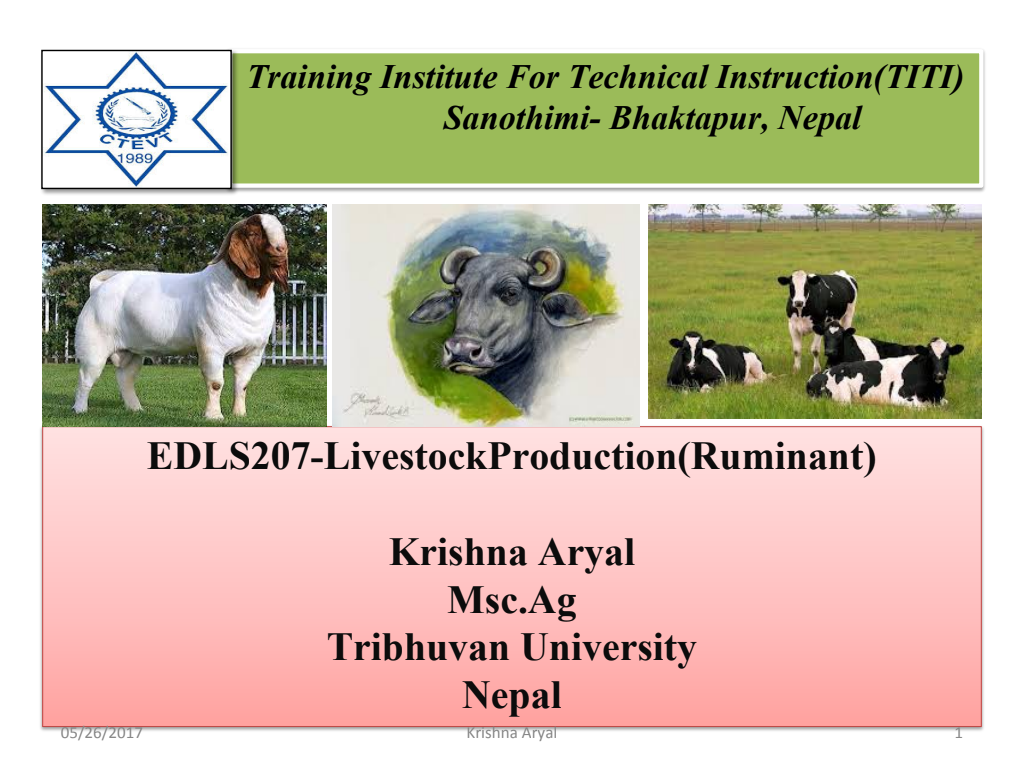
Training Institute For Technical Instruction(TITI) Sanothimi- Bhaktapur, Nepal EDLS207-LivestockProduction(Ruminant) Krishna Aryal Tribhuvan University 05/26/2017 Krishna Aryal
Training Institute For Technical Instruction(TITI)
Training Institute For Technical Instruction(TITI) Sanothimi- Bhaktapur, Nepal Course Outline Introduction ( Animal Husbandary, Ruminants, Body conformation and identification, Importance of ruminant Production, Present status of ruminant production in Nepal) 2. General Management Practices
(common vices in ruminant health, their prevention and care, factors affecting health, general signs of illeness, general care and management) Cattle Production (Origin and distribution, breeds, care and management of calf, heifer, pregnant, milking and dry animals, feeding and management of working bullocks and breeding bulls, reproduction and breeding principles, housing system, health and hygiene) 05/26/2017
Krishna Aryal
Training Institute For Technical Instruction(TITI)
Training Institute For Technical Instruction(TITI) Sanothimi- Bhaktapur, Nepal Animal Husbandry = Animal + Husbandry Animal – Organisms belonging to Kingdom Animalia, Non photosynthetic methods of nutrition, non cellulosic cell membrane and centralized nervous system Husbandry- means ‘to look after’- management(includes proper feeding, breeding, housing, health care and many other activities)
Thus, Animal Husbandry is defined as science as well as an art of management including scientific feeding, breeding, housing, health care of common domesticated animals aiming for maximum return. 05/26/2017 Krishna Aryal
Training Institute For Technical Instruction(TITI)
Training Institute For Technical Instruction(TITI) Sanothimi- Bhaktapur, Nepal 05/26/2017 Krishna Aryal
REQUEST THE COMPLETE DOCUMENT ON WHATSAPP
Training Institute For Technical Instruction(TITI)
Training Institute For Technical Instruction(TITI) Sanothimi- Bhaktapur, Nepal Animal | Kingdom | Phylum | Class | Order | Family | Genus | Species Cattle | Animal | Chordata (with Backbone) | Mamalia (suck their youngs) | Artiodactyla (even toed hoofed) | Bovidae ( 4 chambered stomach,unbranched horns, universal presence of gall bladder | Bos | indicus(humped) taurus(humpless) Buffalo | | | | | | Bubalus | bubalis
Goat | | | | | | Capra | hircus Sheep | | | | | | Ovis | aries Swine | | | | | Suidae | Sus | scorfa Cat | | | | Carnivora | Felidae | Felis | catus Horse | | | | Perissodactyla( Non ruminant hoofed) | Equidae | Eqauus | cabalus 05/26/2017 Krishna Aryal
Training Institute For Technical Instruction(TITI)
Training Institute For Technical Instruction(TITI) Sanothimi- Bhaktapur, Nepal Beginning of Animal Husbandry Old stone age( 1000-6000 B.C.) – Hunting age – no any attempt to domesticate New stone age( 6000- 8000 B.C.) – Started domestication of animals Domestication came after food cultivation First animals to be domesticated – Dog and goat more than 10,000 years ago
( south western Asia in Lebanease and Palestinian mountains) 05/26/2017 Krishna Aryal
Training Institute For Technical Instruction(TITI)
Training Institute For Technical Instruction(TITI) Sanothimi- Bhaktapur, Nepal Ruminants(cattle, sheep and goats) were the first food animals to be domesticated followed by pigs, possibly to dispose of table scraps and waste products. Horses and cattle were domesticated primarily for transportation and draft work purposes.
Early people found animals that form large herds or flocks and eat a wide variety of feeds are easier to domesticate. 05/26/2017 Krishna Aryal
Review questions and answers
What are the key points about Training Institute For Technical Instruction(TITI)?
Training Institute For Technical Instruction(TITI) Sanothimi- Bhaktapur, Nepal EDLS207-LivestockProduction(Ruminant) Krishna Aryal Tribhuvan University 05/26/2017 Krishna Aryal
More lessons from this document
- Ruminant Production — Part 1
- Ruminant Production — Part 2
- Ruminant Production — Part 3
- Ruminant Production — Part 4
- Ruminant Production — Part 5
Conclusion
The important points in Ruminant Production Learning Concepts should be reviewed alongside the definitions, examples and comparisons given above. Continue with the other four articles to cover the rest of the source material.