
Poultry Feeding: Layer Nutrition and Backyard Feeding (Part 4)
Explore “Layer Nutrition and Backyard Feeding” in this Poultry Feeding lesson. Part 4 of the five-part series brings together the source material and lesson topics. Use the contents links to find a section, read the notes, and consult the complete original teaching slides below.
Lesson topics
- Pre-lay phase (17/18 – 20 weeks)
- Protein Requirement for Layers
- Changing Scenario:-Nutrient Requirements of Layers (Phase1 Leeson 2009)
- Comparison of the feed cost /egg over income
- Ideal Amino Acid Recommendations for laying hens
Contents
- Read the original document
- Pre-lay phase (17/18 – 20 weeks)
- A laying hen showing 90% egg prodn. requires 16-18 g of protein and 285 to 290 kcal ME per day.
- Protein Requirement for Layers
- Changing Scenario:-Nutrient Requirements of Layers (Phase1 Leeson 2009)
- Comparison of the feed cost /egg over income
- Ideal Amino Acid Recommendations for laying hens
- Backyard poultry – Feeding strategies
- Rural poultry – nursery rearing
REQUEST THE COMPLETE DOCUMENT ON WHATSAPP
Read the original source document
Concepts in Poultry Feeding: original teaching slides for this study series.
Pre-lay phase (17/18 – 20 weeks)
Reared in 3 phases viz. starter (0-8 weeks of age), grower (8-20 weeks of age) and layer (20 weeks or above) Pre-lay phase (17/18 – 20 weeks) Laying Phase I – 20-42 wks (Increase in body size, egg prodn. & egg wt.) Phase II – 42-72 wks (Minimal wt. gain, egg prodn. decreases)
A laying hen showing 90% egg prodn. requires 16-18 g of protein and 285 to 290 kcal ME per day.
A laying hen showing 90% egg prodn. requires 16-18 g of protein and 285 to 290 kcal ME per day. Meeting Ca requirement is imp. – Ca is increased to about 2% of diet at onset of prodn. WL hens producing 90% eggs require daily about 3.8 to 4.2 g of calcium.
Protein Requirement for Layers
Protein Requirement for Layers Maintenance 2.8g/kg^0.75 3.69 Gain 1g/day 0.17 Egg mass 51.3g/day 6.57 Feathers 0.12 Total 9.77 Protein requirement 17.41g/d (Dig coeff 0.70, BV 0.85) B.Wt 1.35kgs HD egg 95% Egg Wt 54g
Changing Scenario:-Nutrient Requirements of Layers (Phase1 Leeson 2009)
Changing Scenario:-Nutrient Requirements of Layers (Phase1 Leeson 2009) (Mcal/kg)
Comparison of the feed cost /egg over income
Comparison of the feed cost /egg over income Year | Average Egg cost `. | Average Feed cost `/kg | Feed cost Paise/egg | Percentage of feed cost/egg income Aug-2004 | 1.3 | 5.85 | 73.1 | 56 Aug-2009 | 2.09 | 11.87 | 148.4 | 73 Aug-2010 | 2.41 | 14.05 | 175.6 | 73 Aug-2012 | 2.86 | 20.12 | 2.52 | 0.88
REQUEST THE COMPLETE DOCUMENT ON WHATSAPP
Ideal Amino Acid Recommendations for laying hens
Ideal Amino Acid Recommendations for laying hens Source mg/d | Jais et al.,1995 | Leeson and Summers 2005 | Rostagno, 2005 | Bregendahl et al.,2008 | Coon and Zang 1999 | Namakkal | digestible | total | digestible | digestible | digestible | digestible Lysine | 100 | 100 | 100 | 100 | 100 | 100 Methionine | 44 | 51 | 50 | 47 | 49 | 50 M+C | — | 88 | 91 | 94 | 81 | 93 Threonine | 74 | 80 | 66 | 77 | 73 | 76
Tryptophan | 16 | 21 | 23 | 22 | 20 | 23 Arginine | 82 | 103 | 100 | — | 130 | 120 Iso leucine | 76 | 79 | 83 | 79 | 86 | 76 Valine | 64 | 89 | 90 | 93 | 102 | 105 Dig lys =670 to 690mg/d
Backyard poultry – Feeding strategies
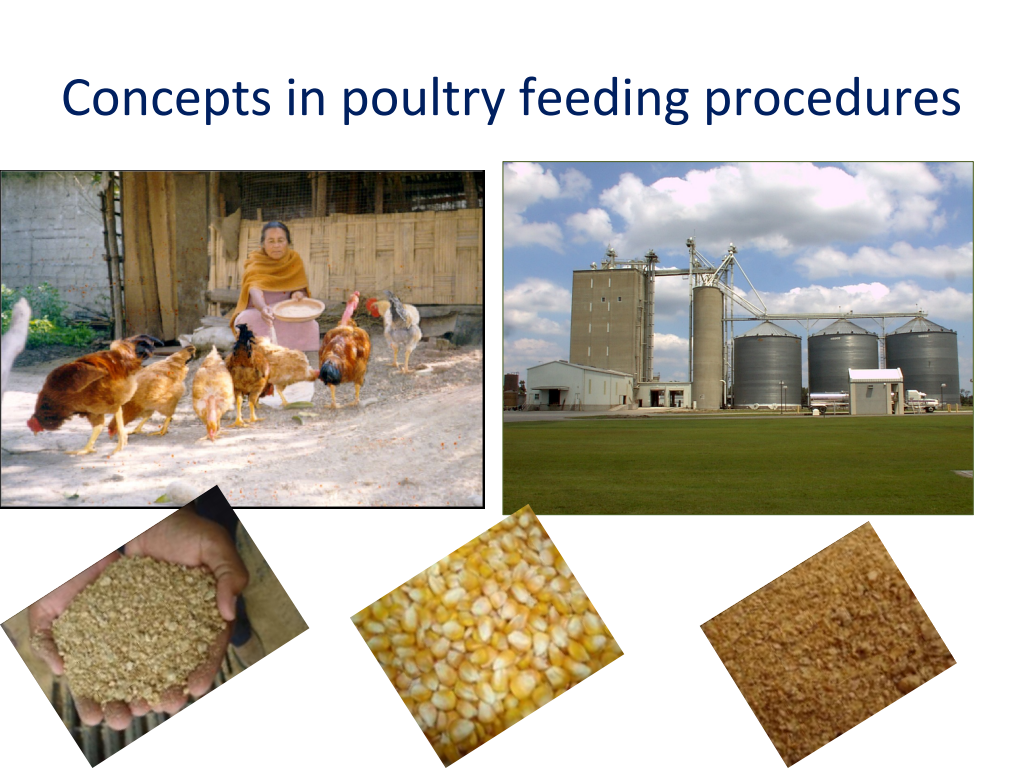
Backyard poultry – Feeding strategies Scavenging Nursery rearing Intensive upto 6-8 wks Subsequently Semi-scavenging Intensive farming
Rural poultry – nursery rearing
Rural poultry – nursery rearing Chicks under rural poultry with improved varieties have no nursing mother Need supplementary heating and protection Nursery rearing till 6-8 wks under confinement ideal To be fed balanced feed
Backyard poultry – Feeding strategies
Backyard poultry – Feeding strategies Fallen cereal grains, grass seeds, oilseeds, insects, earthworms, green tender leaves/grasses, small fishes, snails, aquatic weeds, etc. Occasionally home-grown concentrates like cereal grains, rice polish, rice bran, wheat bran, thrashed fishes/snails and kitchen waste/garbage
Availability of feeds however varies, and depends upon season, number of birds in an area and cropping pattern of that area. Feed availability is more during rainy season and rabi season after harvesting of crops. Scavenging (family / backyard poultry) – low inputs
Review questions and answers
What are the key points about Pre-lay phase (17/18 – 20 weeks)?
Reared in 3 phases viz. starter (0-8 weeks of age), grower (8-20 weeks of age) and layer (20 weeks or above) Pre-lay phase (17/18 – 20 weeks) Laying Phase I – 20-42 wks (Increase in body size, egg prodn. & egg wt.) Phase II – 42-72 wks (Minimal wt. gain, egg prodn. decreases)
What are the key points about A laying hen showing 90% egg prodn. requires 16-18 g of protein and 285 to 290 kcal ME per day.?
A laying hen showing 90% egg prodn. requires 16-18 g of protein and 285 to 290 kcal ME per day. Meeting Ca requirement is imp. – Ca is increased to about 2% of diet at onset of prodn. WL hens producing 90% eggs require daily about 3.8 to 4.2 g of calcium.
What are the key points about Protein Requirement for Layers?
Protein Requirement for Layers Maintenance 2.8g/kg^0.75 3.69 Gain 1g/day 0.17 Egg mass 51.3g/day 6.57 Feathers 0.12 Total 9.77 Protein requirement 17.41g/d (Dig coeff 0.70, BV 0.85) B.Wt 1.35kgs HD egg 95% Egg Wt 54g
What are the key points about Changing Scenario:-Nutrient Requirements of Layers (Phase1 Leeson 2009)?
Changing Scenario:-Nutrient Requirements of Layers (Phase1 Leeson 2009) (Mcal/kg)
What are the key points about Comparison of the feed cost /egg over income?
Comparison of the feed cost /egg over income Year | Average Egg cost `. | Average Feed cost `/kg | Feed cost Paise/egg | Percentage of feed cost/egg income Aug-2004 | 1.3 | 5.85 | 73.1 | 56 Aug-2009 | 2.09 | 11.87 | 148.4 | 73 Aug-2010 | 2.41 | 14.05 | 175.6 | 73 Aug-2012 | 2.86 | 20.12 | 2.52 | 0.88
More lessons from this document
- Concepts in Poultry Feeding — Part 1
- Concepts in Poultry Feeding — Part 2
- Concepts in Poultry Feeding — Part 3
- Concepts in Poultry Feeding — Part 4
- Concepts in Poultry Feeding — Part 5
Conclusion
The important points in Backyard poultry – Feeding strategies should be reviewed alongside the definitions, examples and comparisons given above. Continue with the other four articles to cover the rest of the source material.