
Poultry Feeding: Nutrients, Energy and Amino Acids (Part 1)
Explore “Nutrients, Energy and Amino Acids” in this Poultry Feeding lesson. Part 1 of the five-part series brings together the source material and lesson topics. Use the contents links to find a section, read the notes, and consult the complete original teaching slides below.
Lesson topics
- Concepts in poultry feeding procedures
- Types of rearing chickens
- Feeding management
- In Nutrition,
- Nutrients in feed
Contents
- Read the original document
- Concepts in poultry feeding procedures
- Types of rearing chickens
- Feeding management
- In Nutrition,
- Nutrients in feed
- Expressed as calorie (cal) or joule.
- Plays imp. Role in
- Amino acids
- Limiting Amino Acids Normally deficient in practical diets Methionine – 1st limiting AA in broilers Threo
- Ideal protein concept – precision protein nutrition to minimize the loss of N
- Energy sources
- Energy supplements
REQUEST THE COMPLETE DOCUMENT ON WHATSAPP
Read the original source document
Concepts in Poultry Feeding: original teaching slides for this study series.
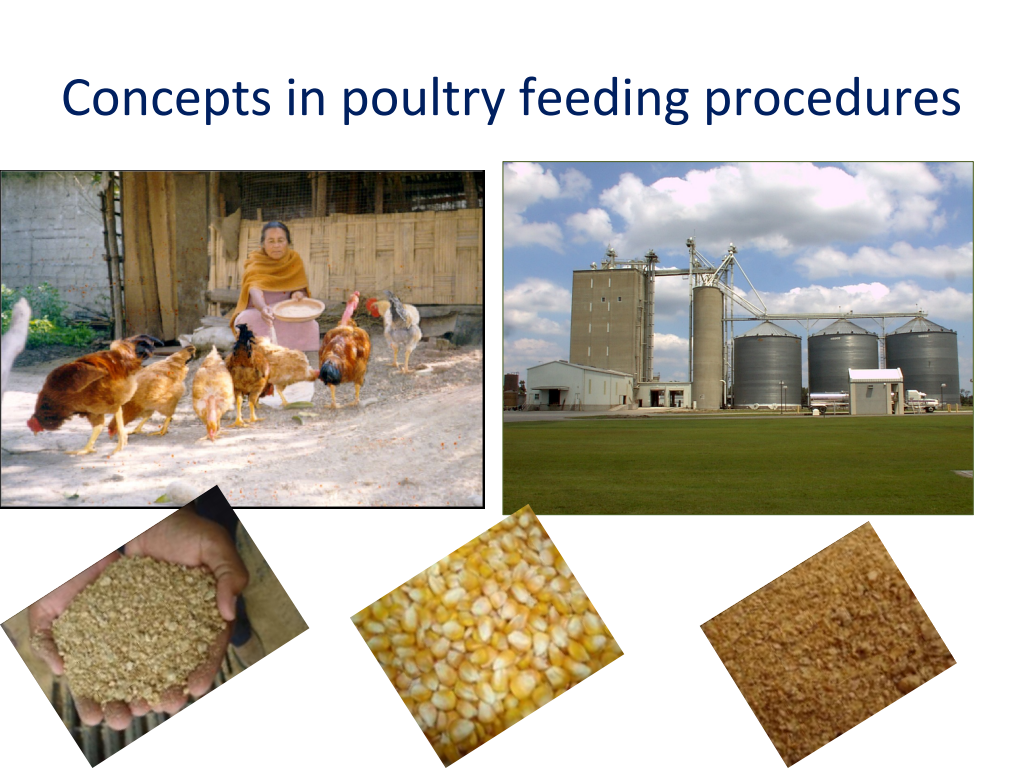
Concepts in poultry feeding procedures
Concepts in poultry feeding procedures
Types of rearing chickens
Types of rearing chickens Intensive Semi-intensive Extensive
Feeding management
Feeding management Objective The objective of a defined feeding management program is to supply a range of balanced diets that satisfy the nutrient requirements at all stages of development & that optimize efficiency and profitability without compromising bird welfare or the environment.
In Nutrition,
In Nutrition, the Three Most Expensive Nutrients are: 2.Amino Acids (protein) 3.Available Phosphorus
Nutrients in feed
Nutrients in feed
Expressed as calorie (cal) or joule.
Expressed as calorie (cal) or joule. One kilocalorie (kcal) = 4.184 kilojoules (kj) kj = 0.239 kcal Requirements are expressed in terms of Metabolizable Energy
Plays imp. Role in
Plays imp. Role in Body structural functions Transportation of nutrients and oxygen Catalyst in chemical reactions (enzymes) Immuno-competence (antibodies) Chemical regulation (hormones) Blood clotting, vision Growth and production Regulating acid-base balance
REQUEST THE COMPLETE DOCUMENT ON WHATSAPP
Amino acids
Amino acids Amino acids are the building blocks 22 amino acids are in nature and build all plants and animals Plants synthesize all the AA Animals synthesize only 12, remaining 10 need to be provided in diet and are essential
Amino acids
Amino acids Essential | Synthesised from limited sources | Readily synthesized Arginine | Tyrosine | Alanine Histidine | Cystine | Aspartic acid Isoleucine | Hydroxylysine | Aspargine Leucine | | Glutamic acid Lysine | | Glutamine Methionine | | Hydroxyproline Phenylalanine | | Glycine Threonine | | Serine Tryptophan | | Proline Valine | |
Limiting Amino Acids Normally deficient in practical diets Methionine – 1st limiting AA in broilers Threo
Limiting Amino Acids Normally deficient in practical diets Methionine – 1st limiting AA in broilers Threonine – 3rd limiting AA for broilers & 1st Limiting AA in starting egg-type pullets. Critical Amino Acids Normally deficient & necessary for protein synthesis initiation Lysine, methionine, meth+cystine, tryptophan, threonine, arginine, isoleucine
Ideal protein concept – precision protein nutrition to minimize the loss of N
Ideal protein concept – precision protein nutrition to minimize the loss of N Digestible amino acid values – permits higher levels of cheaper, alternative protein sources decrease nitrogen excretion by the bird
Energy sources
Energy sources Protein sources Mineral supplements Vitamin supplements Feed additives
Energy supplements
Energy supplements Constitute 60-70% of feed Play an imp. role in cost effective feed formulation and providing bulk. Divided into high energy and low energy supplements High energy suppl. Maize, wheat, broken rice, sorghum, fats and oils Low energy suppl. Pearl millet, finger millet & other small millets, rice polish or bran, DORB, wheat bran, molasses, tapioca flour, etc.
Maize – most popular, can be replaced partially or even completely
Review questions and answers
What are the key points about Feeding management?
Feeding management Objective The objective of a defined feeding management program is to supply a range of balanced diets that satisfy the nutrient requirements at all stages of development & that optimize efficiency and profitability without compromising bird welfare or the environment.
What are the key points about In Nutrition,?
In Nutrition, the Three Most Expensive Nutrients are: 2.Amino Acids (protein) 3.Available Phosphorus
What are the key points about Expressed as calorie (cal) or joule.?
Expressed as calorie (cal) or joule. One kilocalorie (kcal) = 4.184 kilojoules (kj) kj = 0.239 kcal Requirements are expressed in terms of Metabolizable Energy
What are the key points about Plays imp. Role in?
Plays imp. Role in Body structural functions Transportation of nutrients and oxygen Catalyst in chemical reactions (enzymes) Immuno-competence (antibodies) Chemical regulation (hormones) Blood clotting, vision Growth and production Regulating acid-base balance
What are the key points about Amino acids?
Amino acids Amino acids are the building blocks 22 amino acids are in nature and build all plants and animals Plants synthesize all the AA Animals synthesize only 12, remaining 10 need to be provided in diet and are essential
More lessons from this document
- Concepts in Poultry Feeding — Part 1
- Concepts in Poultry Feeding — Part 2
- Concepts in Poultry Feeding — Part 3
- Concepts in Poultry Feeding — Part 4
- Concepts in Poultry Feeding — Part 5
Conclusion
The important points in Concepts in poultry feeding procedures should be reviewed alongside the definitions, examples and comparisons given above. Continue with the other four articles to cover the rest of the source material.